
A Heavily Shorted Tech Leader In Fast Growing Battery Market
The global battery market will grow to a trillion dollars plus by 2035, this company with a tech breakthrough could be a 10-bagger or more.
Clean energy and battery storage have gotten a lot of bad press in the past year despite compound annual growth rates that still lead most other industries. As fossil fuels become more expensive to produce, and climate change becomes a more accepted threat, investors should expect an another massive wave of investment into clean energy and batteries.
Under the most bullish scenarios—factoring in electrification acceleration, renewable integration from the grid to homes, more battery powered devices, a resurgence of EVs and second-life repurposing—the global battery market could reach $1 trillion per year by 2035, with upside potential toward $1.2 trillion at the peak of the storage supercycle, with estimated annual growth rates of 14-18%.
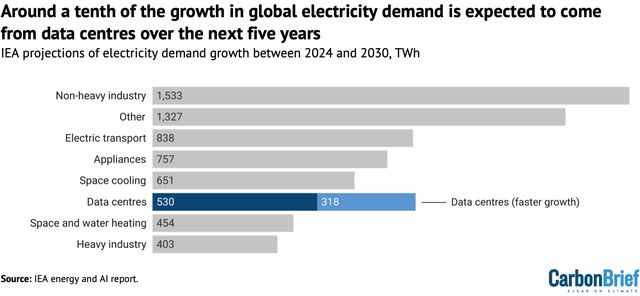
From purely geopolitical and energy security perspectives, clean energy and battery storage needs to grow substantially in the next decade. Energy demand is growing, after a rather flat decade pre-Covid, and AI data centers are a new additive at around 10% of the coming increase in energy needs.
By 2030, global energy storage capacity is projected to soar. It will increase from 28 GW in 2024 to over 400 GW. Batteries are the necessary component of increasing energy demand. Safe and efficient batteries are going to be key to energy security and sustainability.
Lithium-ion Battery Demand
Lithium-ion batteries currently make up roughly 95% of stationary battery storage, i.e. grid scale, and 15% of total installed capacity - but rising quickly.
Grid-scale storage is the fastest growing component of growing energy needs as it allows intermittent resources to power homes and industries at any time of day. Batteries for a growing array of devices and EVs are also experiencing double digit growth rates.
Lithium-ion batteries are well positioned for grid scale storage as rapid discharge rates are optimal for balancing the grid in short durations. But, they are not alone as potential battery sources.
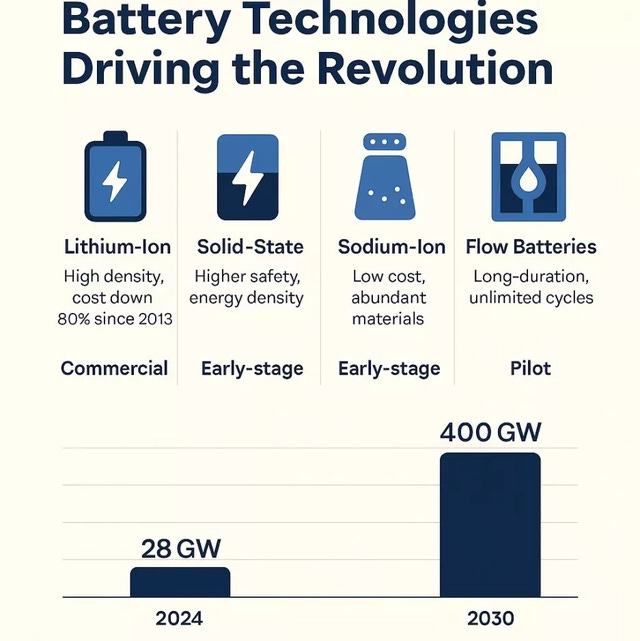
Flow batteries stand as potential partners for grid scale in the next decade as they provide the longer term energy storage at cheaper costs than lithium-ion. Utilities are already in the process of pairing flow batteries with lithium-ion batteries to cover both long-term storage and rapid discharge.
Lithium-ion batteries are used in virtually all devices and EVs.
Aggressive projections place lithium-ion growth rates as high as 23% per year over the next decade. More conservative estimates are in the teen percentages.
With lithium-ion currently dominating growth in multiple markets, growth rates are massive in dollar terms. By 2035, estimates for the lithium-ion battery market range from $377 billion to $798 billion per year.
Battery makers of safe and efficient batteries can see huge growth over the next decade. Companies starting from smaller bases could see the biggest percentage gains in scale and in some cases for shareholders.
The Lithium-ion Fire Problem
The problem of lithium batteries is that thermal runaway, an uncontrolled and self-heating reaction inside a lithium-ion cell can cause the electrolyte to vent and ignite, leading to fire or even explosion.
We recently saw news of the M/V Morning Midas with a shipment of EVs from Asia catch fire in the Pacific. After several days of burning, and abandoning the ship, the vessel was allowed to sink to the bottom of the sea.
We have also heard of Tesla's (TSLA) and other EVs catching fire, as well as, some stationary lithium-ion batteries. We've all felt how hot a cell phone or other devices with a lithium-ion battery can get.
A solution for this problem has been a goal for companies for years. While many battery investors focus on the chemistry of batteries, the real breakthrough appears to have been in the architecture.